
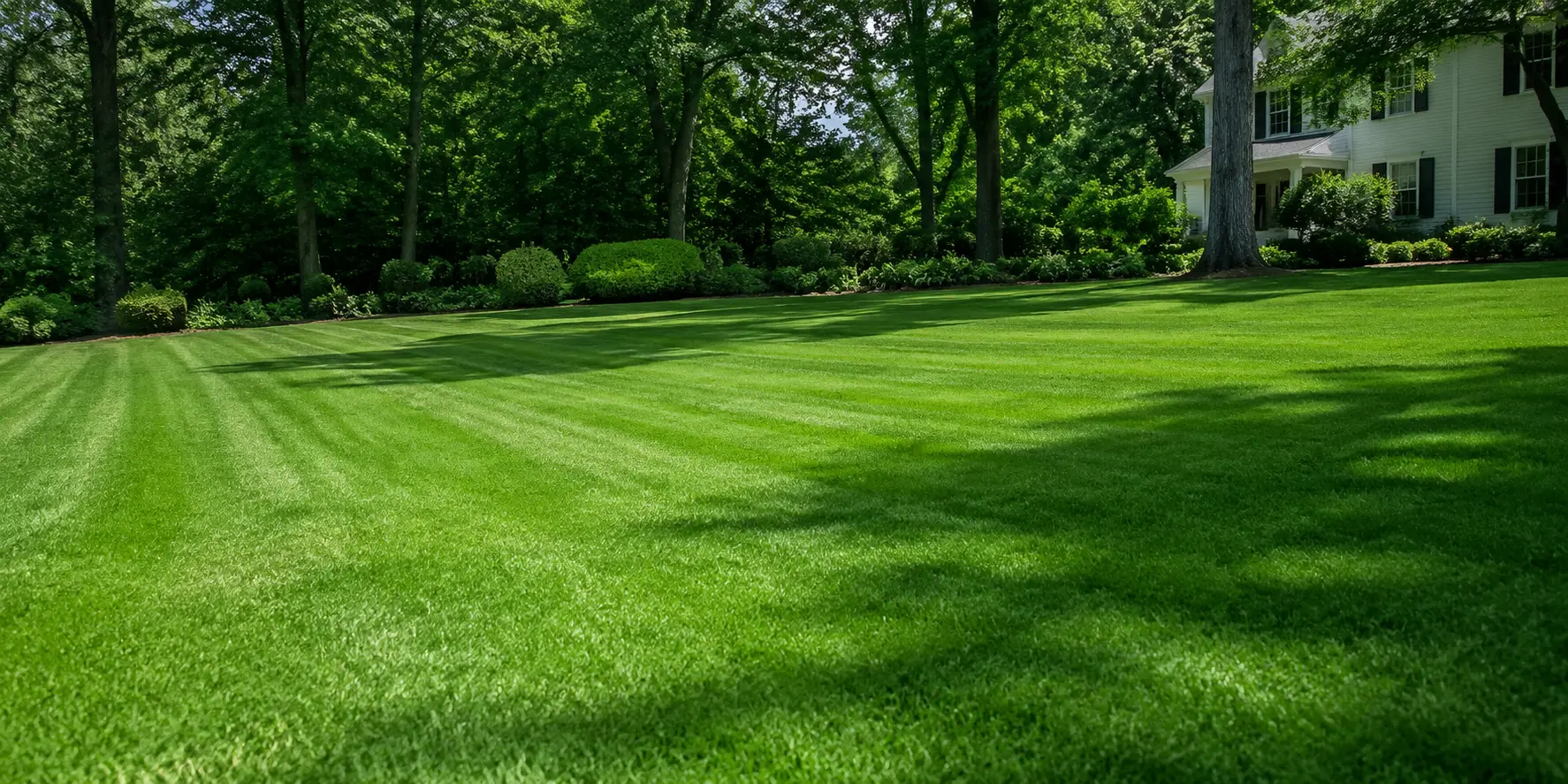
If a lawn in Somers is thin, compacted, or slow to recover from summer, seeding and core aeration can make a visible difference—but only when the timing, preparation, and follow-through line up. Spreading seed on hard ground and hoping for rain is not a renovation plan. Seed needs contact with soil, suitable temperatures, steady moisture, and enough time to develop before the next period of stress.
Northern Connecticut grows primarily cool-season lawn grasses. They are most active when air temperatures are moderate, which makes late summer and early fall the most dependable renovation period. Warm soil speeds germination, cooler nights reduce stress, and many annual summer weeds are becoming less competitive. Spring seeding can work in specific situations, but it comes with extra conflicts: emerging weeds, variable moisture, and the approaching heat of summer.
Green Carpet Lawn Care has worked with lawns in Somers and nearby Tolland and Hartford County communities for more than 25 years. The most successful projects are not necessarily the ones with the most seed. They are the ones that correctly identify why turf thinned, address compaction or soil limitations, select seed for the site, and protect new plants through their first mowings.
Why late summer and early fall usually win
A cool-season seedling has two immediate jobs: produce enough leaf area to capture energy and build enough roots to survive. Late summer soil retains warmth from July and August, so germination can proceed even as daytime air temperatures become more comfortable. Nights lengthen, evaporative demand often eases, and the window before winter can support establishment if the work starts early enough.
This does not mean every property should be seeded on one fixed weekend. Perennial ryegrass can germinate faster than Kentucky bluegrass, while mixtures vary. Heavy shade, limited irrigation, a forecast heat wave, or delayed site preparation can shift the decision. The practical rule is to work backward from the likely end of active growth and give the selected species enough time not merely to emerge, but to mature through several mowings.
When spring seeding makes sense—and what it costs
Spring seeding may be justified after winter damage, construction, utility work, or erosion where bare soil should not remain exposed. It can also be a reasonable repair strategy when the homeowner accepts that additional overseeding may be needed in fall. The challenge is that young grass is entering its first summer with a small root system. It must compete with spring weeds and may need careful irrigation during hot weather.
Preemergence herbicides create another planning conflict because many products designed to prevent crabgrass also interfere with desired grass seedlings. Product labels differ, and some active ingredients or specialized strategies may be compatible with seeding, but improvising is risky. Decide which objective has priority in that area, read the label, and coordinate weed prevention with renovation before either product or seed goes down.
What core aeration actually does
Core aeration removes small plugs of soil and turf, opening temporary channels through the surface. On compacted areas, those channels improve the movement of air and water and give roots space to explore. The plugs break down naturally. Aeration can also help manage thatch and creates many openings where overseed can reach soil instead of resting on leaves.
Aeration is not the answer to every thin lawn. It cannot provide sunlight beneath dense tree cover, repair a broken irrigation zone, change chronically saturated subsoil, or correct an unsuitable pH by itself. It is most valuable where traffic and fine-textured soil have reduced pore space or where a lawn has a genuine surface/thatch problem. A site inspection should separate compaction from shade, drainage, insects, disease, and basic maintenance issues.
How to decide whether your lawn needs aeration
Look for evidence rather than relying on an annual ritual. Compacted areas often feel hard when dry, puddle or shed water during heavy rain, and produce shallow roots or sparse turf in travel lanes. A screwdriver test can be informative: after normal moisture, compare how easily a long screwdriver enters a healthy area and the suspected compacted zone. The test is not laboratory analysis, but a large difference is a useful clue.
Properties with frequent play, pets, riding mowers, delivery traffic, or construction are more likely to benefit. Newly built homes may also have disturbed, layered, or compacted soil beneath a cosmetic topsoil layer. When the problem is isolated, concentrating passes on affected areas can be more sensible than treating every square foot equally. Avoid aerating saturated ground, where equipment can smear soil and cause additional compaction.
Start with soil, sunlight, and the reason turf failed
Before buying seed, count the hours of usable sun and inspect what happens after rain. Turf that receives too little light will remain thin regardless of how often it is overseeded. Water that stands for long periods points to grading, compaction, or drainage constraints. Tree roots can compete for moisture, and roadside areas may face heat and winter salt. Renovation succeeds when the plant is matched to the environment—or when the environment can be realistically improved.
A soil test adds objective information. UConn’s standard nutrient analysis reports pH, phosphorus, potassium, calcium, magnesium, micronutrients, and a lead scan, along with site-specific fertilizer and pH recommendations. UConn’s organic lawn-care guidance says lawns generally perform best with four to eight inches of topsoil, good drainage, moderate organic matter, adequate nutrients, and a pH between 6 and 7. Those are useful targets, not reasons to add amendments without test results.
Choose seed by site—not by the picture on the bag
A quality seed label is a decision tool. It lists grass species and cultivars, germination percentages, weed seed, other crop seed, inert matter, and lot information. For sunny northern Connecticut lawns, turf-type tall fescue is often valued for its deeper-rooted, bunch-type growth. Kentucky bluegrass can form a dense sod and spread through rhizomes but is slower to germinate and may require more water and fertility. Perennial ryegrass establishes quickly and is often used in mixtures. Fine fescues can be useful in lower-input or partly shaded settings.
No seed is truly shade-proof, traffic-proof, or drought-proof. A mixture spreads risk, but every component should suit the site. Avoid bargain blends with high percentages of annual ryegrass, unspecified varieties, weed seed, or inert material. Also calculate area before buying. Applying the labeled rate evenly is better than dumping extra seed on visible bare spots, where crowding can create weak seedlings and disease-prone growth.
Prepare the surface for seed-to-soil contact
Seed cannot root into a layer of loose thatch or sit indefinitely on top of existing leaves. Mow the renovation area somewhat lower than the regular height without scalping, remove heavy debris, and expose soil where necessary. Core aeration supplies openings; slit seeding mechanically places seed into shallow grooves; small bare areas can be loosened and raked by hand. The right method depends on lawn density and scale.
After seeding, keep seed on the property. Slopes and downspouts may need erosion control or redirected water so a thunderstorm does not move the entire investment downhill. A light, appropriate mulch can help bare-soil repairs retain moisture, but thick material can block light and emergence. Do not bury lawn seed deeply. Follow the seed label and equipment settings, and make passes in different directions for more even distribution.
Water for germination without creating runoff
New seed has different water needs from an established lawn. During germination, the upper surface must stay consistently moist, which usually means brief, gentle applications more often than a mature lawn would need. The goal is moisture—not puddles. As seedlings emerge and roots lengthen, transition gradually toward less frequent, deeper watering. An abrupt switch from constantly damp soil to neglect can lose young plants quickly.
Coverage matters as much as schedule. Place straight-sided containers across each irrigation zone to find dry and overly wet locations. Watch shaded sections, slopes, pavement edges, and areas near large trees separately. EPA WaterSense reports that as much as half of outdoor water use may be lost to wind, evaporation, and runoff from inefficient irrigation. Early correction of a clogged nozzle or overspray protects both the seedlings and the water bill.
The first mowing is part of establishment
Do not wait for new grass to flop over. Mow when seedlings are tall enough for the intended height and the soil is firm enough that equipment will not rut or pull plants out. Use a sharp, clean blade, turn gently, and remove no more than roughly one-third of the leaf at a time. Early mowing encourages tillering in suitable grasses and keeps taller existing turf from shading seedlings.
Traffic should remain light during establishment. Dogs running the same path, children playing on damp soil, and heavy riding equipment can undo careful preparation. Fallen leaves are another local challenge. Remove them gently and frequently instead of allowing a dense mat to stay on seedlings for a week. A blower used carefully may disturb the surface less than aggressive raking.
Fertilizer, lime, and phosphorus require evidence
Starter fertilizer is not automatically required simply because seed is being applied. The soil test, current fertility, product analysis, selected seed, and Connecticut rules should guide the decision. Phosphorus is important to plant growth, but excess phosphorus contributes to water-quality problems. UConn notes that Connecticut regulates phosphorus fertilizer for established lawns while allowing it in connection with new seeding or overseeding. Follow current law and the label.
Lime is also not food for grass. It changes soil chemistry and should be applied only when testing indicates a need. Too much can create new nutrient-availability problems. UConn recommends testing every few years and when established plantings are not performing. If renovation keeps failing despite good seed and watering, objective soil information is one of the highest-value next steps.
Common renovation mistakes we see
The most common failure is a chain rather than a single error: work starts too late, seed is chosen by price, the surface is not opened, irrigation coverage is uneven, and leaves smother the slowest areas. Another frequent mistake is seeding without correcting the cause of thinning. Compacted play areas return because traffic continues; deep shade stays deep shade; low spots remain wet. Renovation is a reset, not magic.
Avoid applying an herbicide or fertilizer without checking compatibility and timing. Avoid heavy irrigation that carries seed away. Do not assume more seed is better, and do not stop watering the day green fuzz appears. Finally, judge the stand after it has matured, not at first emergence. Different species germinate at different speeds, and a mixed lawn may fill in unevenly before becoming uniform.
- Starting after the realistic fall establishment window has narrowed.
- Using seed that does not match sun, moisture, and traffic conditions.
- Skipping soil contact or allowing seed to wash into low spots.
- Keeping the surface flooded instead of evenly moist.
- Ignoring shade, drainage, compaction, disease, or irrigation defects.
A practical Somers renovation sequence
Begin with a walk-through and define the problem areas. Measure the lawn, obtain soil results when needed, select a seed mixture, and coordinate any weed-control restrictions. Mow and prepare the surface, core-aerate where compaction warrants it, distribute seed evenly, and apply only amendments that the plan supports. Test irrigation coverage immediately so the first watering is not also the first troubleshooting session.
Then protect the work. Maintain surface moisture through germination, transition watering as roots develop, mow on time with a sharp blade, manage leaves, and limit traffic. Green Carpet Lawn Care can help homeowners decide whether overseeding, aeration, soil correction, or a different approach is the best use of their budget. A candid evaluation matters: sometimes the durable answer is improving sunlight or drainage before another pound of seed is applied.
Seeding & Aeration Timing FAQs
What month should I aerate my lawn in northern Connecticut?
Late August through early fall is often the most useful period because cool-season turf is entering active growth and aeration can be paired with overseeding. Exact timing depends on soil moisture, weather, turf condition, and how much establishment time remains.
Should I aerate before or after overseeding?
Core-aerate first, then overseed promptly so seed can reach soil through the openings and disturbed surface. Other methods, such as slit seeding, may be better for specific sites.
Can I seed in spring in Somers?
Yes, especially for necessary repairs, but spring seedlings face weed competition and summer stress sooner. Spring preemergence weed control may also conflict with germination. Plan product timing carefully and expect closer watering.
How long should I water new grass seed?
Keep the surface consistently moist through germination with light applications that do not puddle or cause runoff. As seedlings establish, gradually reduce frequency and increase depth. Duration varies by species, weather, soil, shade, and irrigation coverage.
Will aeration fix a shady lawn?
No. Aeration can relieve compaction and improve soil exchange, but it cannot replace adequate light. Dense shade may require pruning where appropriate, a more shade-tolerant groundcover, or redesign rather than repeated seeding.
Sources
We used the following authoritative resources to verify the agronomic guidance, regulations, and statistics in this article. Accessed August 13, 2026.
- Soil Testing — UConn Home & Garden Education Center
- Organic Lawn Care — UConn Home & Garden Education Center
- Statistics and Facts — U.S. EPA WaterSense
- Watering Tips — U.S. EPA WaterSense
Editorial note: This article provides general educational information for northern Connecticut home lawns. Product labels, current state requirements, weather, and property conditions take priority. Diagnose a problem before treatment.