
Use soil results to guide care
Base lime and nutrient recommendations on testing rather than assuming every Hebron lawn has the same soil.
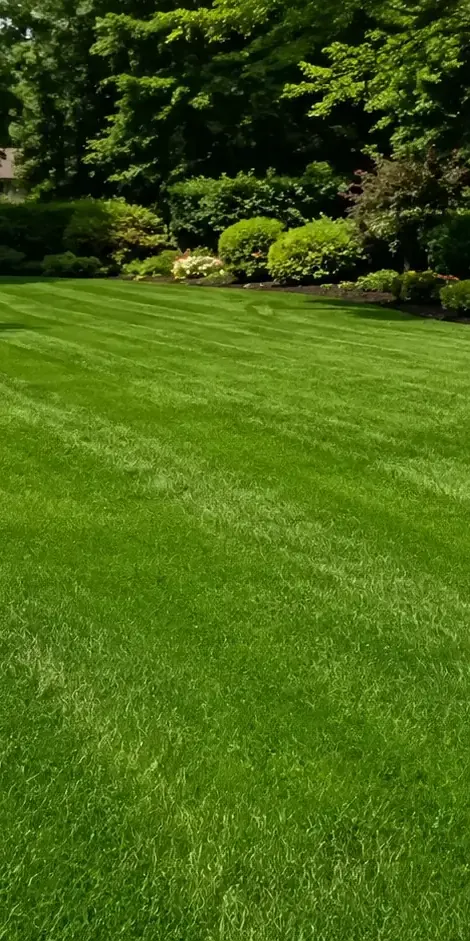
Thoughtful lawn treatment programs for Hebron homes, with practical recommendations for soil health, wooded edges, uneven moisture, and seasonal lawn repair.
Get Your Free EstimateYes. Green Carpet Lawn Care provides residential lawn, tree, and shrub services in Hebron, Connecticut, from our nearby Somers office. Service is subject to route availability and a property-specific estimate.
On a Hebron property with both open turf and wooded boundaries, the lawn should be evaluated in sections. A thin strip near the woods may face limited light and root competition, while an open area may need attention to watering, soil condition, or wear. We look for those differences before proposing a program.
Recurring moss, poor growth, or a patch that fails after every seeding deserves more investigation than another bag of fertilizer. A soil test can clarify nutrient and pH needs; a property visit can identify visible limitations such as shade or ponding. We explain what a lawn treatment can reasonably improve and where a drainage or landscape change may be needed first.
Base lime and nutrient recommendations on testing rather than assuming every Hebron lawn has the same soil.
Map persistent puddles and fast-drying spots. Fertilization and aeration cannot substitute for resolving an underlying drainage issue.
Match seed selection and timing to sunlight, site preparation, and the watering you can provide after the work.
We do not assume every property needs every treatment. After evaluating turf density, weeds, insects, soil, light, moisture, and your goals, we can recommend a focused seasonal plan.
Green Carpet Lawn Care was established in 2001 and is owned by Joseph and Nancy Baj. Our local experience helps us recognize recurring north-central Connecticut turf patterns, but we still evaluate the individual property before recommending work.
Connecticut homeowners can independently verify core lawn-care principles through public resources. UConn Extension explains that soil testing can identify pH and nutrient imbalances before lime or fertilizer is added. The Connecticut Agricultural Experiment Station documents the life cycles and turf damage associated with white grubs. Connecticut DEEP publishes consumer guidance for organic and lower-impact lawn care.
Yes. We consider shade, roots, leaf accumulation, moisture, and turf condition. Seeding is recommended only where the site can support the grass being planted.
Not necessarily. Moss may accompany shade, moisture, compaction, or fertility problems. Soil testing helps determine whether lime is appropriate; it does not diagnose every physical site problem.
We can recommend seeding and related lawn services after evaluating the cause of the bare ground. Timing, preparation, watering, and any recent herbicide use affect the plan.
Tell us about your property and we’ll recommend a plan designed for Connecticut’s climate.